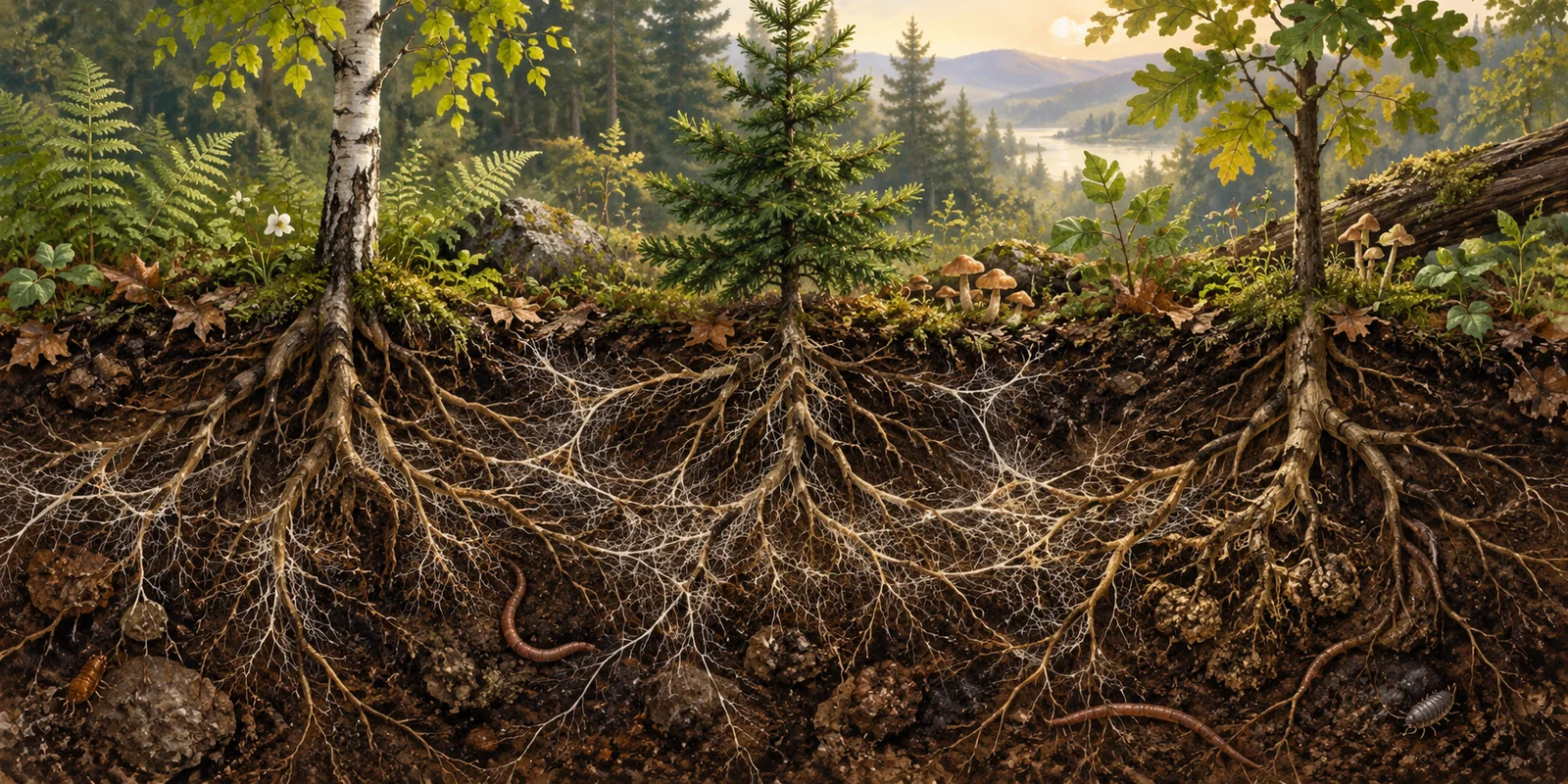


Last time, we looked up: at an open sea of scattered islands, and the flags a person might fly to stop being someone else’s cargo. This time, look down. Under the floor of every healthy forest runs a network older than any human one: a living web of fungal threads that laces tree to tree to shrub to soil, moving water and food and chemical news through the dark. It is the closest thing the planet has to a fibre-optic web, and it was here four hundred million years before we strung the first cable.
We keep reaching for that network to explain ourselves. Our own homepage does it. It points at Tesla building its own nervous system, an in-house ERP called Warp that wires together every bolt, every person, every decision. Then it says, plainly, that beneath every forest a mycelial network connects the trees, and that data should work like soil: an open foundation that lets everything grow. This essay is the long version of that thought. It’s about nervous systems (the kind a body has, the kind a company has, the kind a forest has) and what keeps one healthy, what makes one sick, and how you bring a sick one back.
What’s actually down there
The threads are fungi. A single thread is a hypha; a mat of them is mycelium. Most of the fungi we care about here are mycorrhizal, “fungus-root”, and they live in a partnership with plants so common it’s nearly the rule rather than the exception: somewhere around ninety percent of plant species form these associations. The fungus threads into or around a plant’s roots and extends its mycelium out into the soil, foraging a volume of earth the roots alone could never reach.
And then they trade. The plant pulls carbon out of the air through photosynthesis and hands a generous cut of it (for some partnerships, twenty or thirty percent of the sugar it just made) down to the fungus. The fungus, in return, mines the soil for water and the minerals plants struggle to get on their own, chiefly nitrogen and phosphorus, and delivers them up to the root. Carbon down, minerals up, on a standing account. It is one of the oldest economies on Earth, and it is built on reciprocity, not extraction.
The scale is genuinely hard to picture. A single cubic centimetre of forest soil can hold up to two kilometres of mycelium. The fine threads don’t just move nutrients; they wrap around soil particles and glue them into crumbs, building the structure that lets soil hold water and air. Add it all up and mycorrhizal fungi turn out to be one of the most overlooked pipes in the planet’s carbon cycle. Recent work estimates the equivalent of around thirteen billion tonnes of CO₂ flows from plants into mycorrhizal fungi every year, roughly a third of what humans burn in fossil fuels. The life cycle that maintains all this is unhurried: a spore germinates, sends out hyphae, the mycelium colonises roots and trades for years, occasionally throwing up a mushroom, the fruiting body, to scatter the next generation of spores. The mushroom is only the part that surfaces; the organism is the network.
Before this runs away with us, the honest part, because the popular story about this network has run ahead of the evidence.
What the science actually says about the “Wood Wide Web”
A metaphor that flatters itself is just more marketing. Here’s the honest version.
- ✕
We won’t claim the forest is a conscious “internet of trees.”
✓The romantic version — wise “mother trees” knowingly nursing their kin through fungal cables — outran the field evidence. A 2023 wave of papers showed the popular story was amplified by positive citation bias, and the debate is still live.
- ✕
We won’t personify the network.
✓What’s real and well-established is the architecture: mycorrhizal symbiosis is nearly universal, the carbon-for-nutrients trade is textbook, and mycelium is one of the planet’s largest living carbon pools — a vast, redundant, decentralised exchange web.
- ✕
We won’t pretend a metaphor is a proof.
✓A forest isn’t a database and xNet isn’t a fungus. We borrow the shape — reciprocal, decentralised, no single point of control — because the shape is what’s worth building, and decline the parts the evidence can’t carry.
So we’ll keep what survives the scrutiny, which is plenty: a real, reciprocal, decentralised exchange network with no boss and many redundant paths. That architecture is the useful part. And it turns out to be the same architecture that keeps other living systems well.
Three nervous systems, one shape
Step back far enough and a forest’s fungal web, a body’s nervous system, and a company’s data backbone start to look like the same machine running at three different scales. Each is a connective substrate: a tissue whose whole job is to let the parts sense each other, share resources, and adapt together, without a single dictator deciding everything from the centre.
Three nervous systems, one shape
A body, a company, and a forest all run on the same idea: a decentralised connective substrate — sense, share, adapt, with no dictator in the middle.
-
A body
Neurons + the vagus nerve
Senses, signals, and regulates — then rests and recovers. Health shows up as steady vagal tone and the ability to return to calm.
-
A company
One owned data backbone (Tesla’s Warp ERP)
Every bolt, person, and decision connected on a backbone the company owns and can adapt — instead of renting it from a vendor who also harvests it.
-
A forest
The mycorrhizal network
Water, carbon, and minerals traded root-to-root along fungal threads — redundant paths, no single point of failure, no central nursery in charge.
The same axis decides whether any of the three is well or sick: biodiverse · decentralised · reciprocal · regulated · regenerative on one end, monoculture · centralised · extractive · dysregulated · brittle on the other.
The body’s version is the one we feel from the inside. A well-regulated nervous system can ramp up to meet a threat and then, crucially, come back down: what physiologists measure as healthy vagal tone and heart-rate variability. The forest’s version is the mycelial trade. The company’s version is the part our homepage points at: Tesla owns Warp and can rewire it on a whim, while most companies rent their nervous system from software vendors who bill them for it and quietly harvest it at the same time. Same shape, three scales. And the thing about a nervous system is that it can go wrong in the same way at every scale, too.
What dysregulation looks like, and who profits from yours
A healthy network is biodiverse, decentralised, reciprocal, and able to rest. Take any of those away and you can watch it sicken.
Cut a varied forest down and replant it as a single species in tidy rows, and the underground web frays. Study after study finds that monoculture plantations carry less fungal diversity than the forests they replaced, and that fungal diversity is the single best predictor of whether the soil still works. Let the same ground regrow on its own, with its mix of species, and the network knits back toward the old composition; hold it as monoculture and it mostly doesn’t. The brittleness compounds: less diversity below ground means more pests, less drought resistance, acidifying soil, and a standing risk of collapse. A monoculture looks orderly and is secretly fragile.
A body does the exact same thing under chronic stress with no recovery. Keep the system switched on, alarm without rest, and the wear accumulates as what researchers call allostatic load: heart-rate variability falls, vagal tone depletes, and the longer it stays revved the harder it becomes to climb back down to calm. And one of the most reliable things that suppresses a nervous system is isolation; one of the most reliable things that restores it is safe connection. A nervous system starved of diverse, trusted contact dysregulates, exactly like a forest starved of biodiversity.
Now hold that picture against the internet most of us actually use. It is a monoculture: a few enormous platforms in tidy rows, where most people never leave the islands the algorithm sails them to. It is the opposite of restful by design: an attention economy whose whole engine is to keep your nervous system slightly dysregulated, refreshing, never quite at rest. And it runs on extraction rather than reciprocity. We laid out the receipts on a separate page, every claim cited: over three years, an average person’s data was reported to a single platform by roughly 2,230 different companies; about 99% of people can be uniquely fingerprinted from their device alone. In a forest, the network feeds you. In this one, you are the cargo, the same turn we reached in the pirate essay, seen now from below the soil instead of above the waves.
Data should work like soil
Here’s where the metaphor stops being a metaphor and turns into an architecture, the same move the pirate post made with flags and ships’ logs. If a healthy network is decentralised, reciprocal, and owned by no one in the middle, then you can build one. xNet is, almost literally, mycelium for your data.
- A spore of your own. Your identity is a
did:key, a key pair you generate on your own device. No registry issues it and no authority can revoke it. Like a spore, it carries everything it needs to start, anywhere. - Your own roots. Your data lives on your device first, in a local store that works with no network at all. That’s the root ball, alive whether or not it’s fused to anything else right now.
- Signed packets along the hyphae. Every change you make is signed by you and chained to the one before it, so the record can’t be quietly rewritten later, not even by us. Each change is a packet of nutrient travelling a thread, with your mark on it.
- Trade on purpose. When one root wants to share with another, it hands over a signed grant that says “you may draw on this”, directly, with no central nursery approving the exchange. Carbon down, minerals up; reciprocal and permissioned, never extracted.
- A shared biochemistry. Different species can only trade because they speak a shared chemical language. xNet’s version is an open protocol, written down and pinned to a corpus of shared test vectors any implementation in any language has to pass, which is why you can build on it in Swift, Rust, or Python and still interoperate.
- Soil as a commons. The data structures themselves, the schemas, are a shared, extensible substrate, “like npm for data types,” so an app you’ve never heard of can grow in the same earth as yours. Open foundation; everything grows.
That’s what our homepage means by owning your nervous system instead of renting it. Tesla had to build Warp to get it. The point of an open protocol is that you don’t have to be Tesla; the substrate is there for anyone to root into.
How you bring a network back
The best part of the forest story is that damage isn’t destiny. You can heal a wrecked one, and the way you do it is the same at every scale, which is the most hopeful thing in this whole essay.
You don’t command a forest back to health; you tend it. Restoration ecologists will tell you the moves that work are never a single silver bullet. You stop the active harm, then rebuild the soil’s structure and its diversity together. Then, the lovely part, you re-inoculate with native fungi, and the inoculants that work best are diverse local consortia, not one heroic species. Reintroduce the network and it does the rest: it drives succession, lifts seedling survival on poor ground, even helps fend off invasives. Then you wait, because soil keeps its own slow time. Diversity, reciprocity, patience. That’s permaculture; that’s also just how living networks knit.
A dysregulated nervous system comes back the same way, not by force but by the right conditions: rest, safety, and a return of diverse, trusted connection. And a dysregulated internet comes back the same way too, which is the whole reason xNet is shaped the way it is. Stop the extraction by owning your data instead of being it. Restore biodiversity by federating: many hubs, many apps, no monoculture, and the freedom to choose your own waters rather than crowning a new authority to choose for you. Restore reciprocity by making every share a deliberate, revocable grant. And restore rest: xNet’s Humane Charter is enforced in the build itself: a check that bans the machinery of compulsion, no infinite scroll, no engineered streaks, no behavioural-surplus trackers. It is, quite literally, a rule against clear-cutting your attention.
A forest’s nervous system, a body’s, a company’s, an internet’s: each is well when it’s diverse, decentralised, reciprocal, and free to rest, and each goes sick when it’s reduced to a monoculture run for someone else’s extraction. The good news is that the cure is known, and it’s gentle. Tend the soil. Bring back the diversity. Trade fairly. Let it rest. Then watch what grows.
So: root in. Use the app, free, offline, and private. Read the commitments we’re built on. Or, if you build things, grow something in the open soil yourself. Last essay we set out to sea. This one, we put down roots. Same open world; just look down.
Sources
- The mycology — symbiosis, the carbon-for-nutrients trade, scale and carbon storage: SPUN — Mycorrhizal Fungi Explainer, University of Wisconsin — Mycorrhizae, and “Mycorrhizal mycelium as a global carbon pool,” Current Biology (2023).
- The honest counterweight — why the “Wood Wide Web” / “mother tree” story is contested: Henriksson et al., New Phytologist (2023), the Karst, Jones & Hoeksema review in Nature Ecology & Evolution (2023), and Suzanne Simard’s response (the debate is live, not settled).
- Monoculture, fungal diversity, and restoration: monoculture vs. natural regeneration, Environmental Management (2023) and arbuscular mycorrhizal fungi in the restoration of degraded lands.
- The body’s nervous system — allostatic load, vagal tone, isolation vs. connection: allostatic load and nervous-system regulation.
- Tesla’s Warp as a company’s “central nervous system”: an overview of Warp.
- The surveillance figures and their citations: xNet — Why. The architecture and commitments: the Humane Charter. The companion essay: A Great Pirate Age for the Internet.
This is an independent essay. The “Wood Wide Web” and “mother tree” are popular terms for a contested area of active science, used here as metaphor, not settled fact. Tesla and Warp are referenced as commentary; xNet is not affiliated with, authorized by, or endorsed by Tesla, Inc. or any researcher cited above. All artwork here is original.