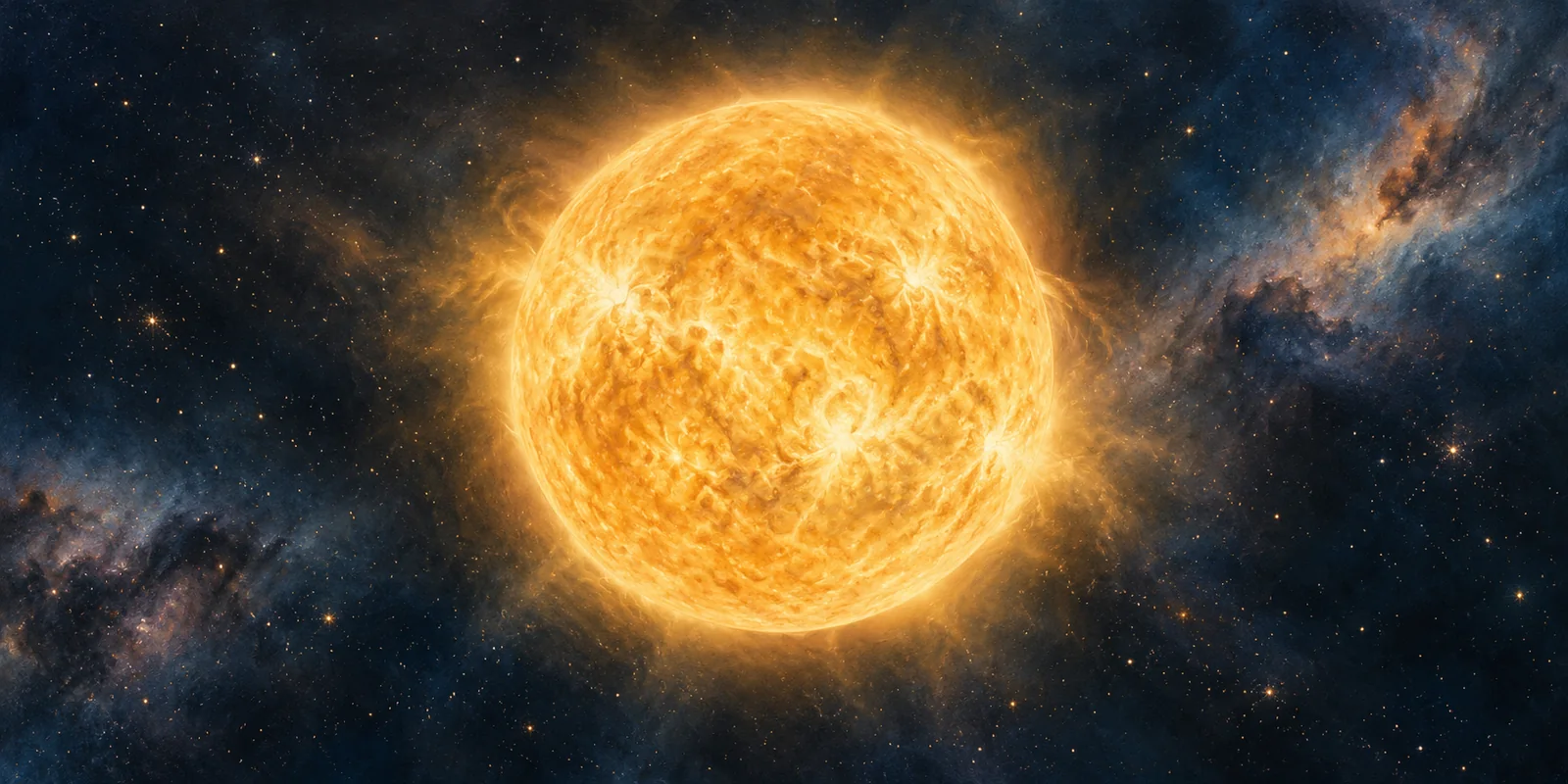


The first time, we looked up: at an open sea of scattered islands, and the flags a person might fly to stop being someone else’s cargo. The second time, we looked down: under the forest floor, where a fungal network older than any human one trades food and news in the dark. This time, look up again. All the way up. Past the sea, past the canopy, to the thing that has been sitting in our own logo the whole while: a star.
Here’s the fact that should reorganise how you think about it. The Sun pours out the energy of billions of bombs a second, and yet (measured where the fusion actually happens, in its core) it produces only about 276 watts per cubic metre. That is not the power density of a bomb. It’s closer to a compost heap, or a reptile’s metabolism. A garden bed quietly rotting puts out about as much heat per litre as the centre of the Sun. The Sun is overwhelming not because it burns intensely but because it is vast, and slow, and in no hurry at all. Hold onto that, because it turns out to be the whole essay: the gentlest furnace in the sky is gentle on purpose, and we can learn how it does it.
Why a star doesn’t explode, and doesn’t freeze
A star spends almost its entire life in a state physicists call hydrostatic equilibrium. Two enormous forces are locked against each other: gravity, crushing every layer inward toward the centre, and the outward pressure of hot gas and radiation, pushing back. At every depth, the two are matched. That alone would just be a tense stalemate. What makes it stable, what the sun has that a stick of dynamite doesn’t, is that the balance is self-correcting.
Suppose gravity gets the upper hand for a moment and the core contracts. Squeezing it makes it hotter; a hotter core fuses faster; faster fusion raises the pressure; and the extra pressure pushes the layers back out. Now suppose the opposite: the core puffs up and cools; fusion slows; the pressure drops; and gravity pulls it back in. Any nudge toward catastrophe triggers the exact response that cancels it. A star is, in the plainest engineering terms, a thermostat: a loop that pushes back toward the middle. That is why, in your words, it doesn’t explode and it doesn’t freeze. It isn’t being held still by willpower. It’s being held by a governor.
Engineers have a name for that kind of loop (negative feedback) and a name for its evil twin. In positive feedback, a nudge in one direction triggers a response that makes the nudge bigger: the squeal of a microphone held too close to its own speaker, a stampede, a run on a bank. Positive feedback has no middle to return to. It runs until it hits a wall. Keep this distinction in your pocket; we’re about to meet a machine built entirely out of the second kind.
Two ways to wire the same machine
A star stays whole because it has a governor. An attention feed stays profitable because it doesn't.
-
A star
Negative feedback (a thermostat)
Squeeze the core and it heats, fusion speeds up, and pressure pushes back out. Let it expand and it cools, fusion slows, and gravity pulls it back in. Any nudge is self-corrected — so it neither explodes nor freezes.
-
An attention feed
Positive feedback (no governor)
Engagement is rewarded with more engagement: refresh, alert, streak, repeat. Nothing pushes back toward rest, so the system runs hotter and hotter — the stellar equivalent of a giant that burns blindingly bright and then burns out.
The same axis decides which one you get: self-regulating · bounded · long-lived on one end, runaway · maximal · burns out on the other.
How information got lighter, and we got heavier
Step back and look at our species the way you’d look at a star: by its energy. For most of history, to move an idea you had to move matter. You carved it into stone, pressed it into clay, inked it onto skin and pulp, bound it into books and carried the books over mountains. Information travelled at the speed of a mule, and every copy cost a forest of effort. Then the printing press made copies cheap. Then we learned to send thought as electrons down a copper wire (the telegraph, the telephone) and the mule fell away. And now we send it as photons: pulses of light down hair-thin glass, and radio through the open vacuum of space. More than 99% of the world’s intercontinental data now travels as light through fibre. Each rung of that ladder is faster, subtler, and cheaper in energy per bit than the one before.
It costs less, but it never costs nothing. There’s a beautiful law here, Landauer’s principle, which says that even to erase a single bit of information has a minimum, unavoidable energy cost, paid out as heat. Rather than some ghostly stuff floating above the physical world, information is physical. It has a thermodynamic price, the same as a falling rock or a burning log. We have spent ten thousand years learning to pay that price more and more cheaply: climbing from atoms to electrons to photons, into the fastest-moving, most invisible layer of our own physics.
And something strange happened on the way up. As information got lighter, we got heavier. We tapped into that quick, subtle layer of the world and wired ourselves directly into it, and our bodies, which still keep time in heartbeats and seasons, never got the upgrade. We became more mental, more abstract, more anxious, adapting ourselves to loops that consume our attention, our awareness, our hours. In climbing the energy ladder of information we left our nervous systems standing at the bottom.
The loop with the governor removed: who profits from it
Remember positive feedback, the squeal, the stampede, the system with no middle to return to? That is the precise shape of the attention economy. An engagement feed is engineered so that the reward for your attention is a reason to give more attention: the refresh that loads one more post, the notification that pulls you back, the streak you mustn’t break, the bottomless scroll designed never to reach an end. There is no force in that system pushing you back toward rest. By design, there can’t be: rest is the one outcome it can’t afford.
In stellar terms, the platforms aren’t building you a sun. They’re building you a supergiant: the rare, massive kind of star that blazes thousands of times brighter than ours and pays for it by living fast and dying young, burning through in a few million years and detonating, where a small, frugal star would have lasted for trillions. We even use the star’s own word for what happens to a person run on that loop. We call it burnout, and not by accident.
And the heat is the point, because someone is selling it. The whole engine runs on keeping your nervous system a little dysregulated, a little revved, a little unable to put the thing down, because a calm person is a worse customer. We laid out the receipts on a separate page, each one cited: over three years, an average person’s data reached a single platform from roughly 2,230 different companies; combining the quirks of your browser and device can pick you out of the crowd, about 99% of the time, with no cookie at all. In a star, the energy flows outward to warm a whole solar system. In this one, it flows the other way: you are the fuel, and you are being burned. It’s the same turn we reached in the pirate essay: there you were the cargo; here you are the fuel, seen now by starlight.
Before we reach for the star as a model, one honest caveat, because the cosy version of the Sun is oversold, the same way the “Wood Wide Web” was.
An honest star
A metaphor that flatters itself is just more marketing. Here’s the honest version.
- ✕
We won’t pretend the Sun is serene.
✓Up close it’s violence: a 15-million-kelvin core, a surface that hurls flares and coronal mass ejections. The calm we feel is a gift of scale and ninety-three million miles of distance — not the absence of fury.
- ✕
We won’t pretend the balance is forever.
✓Equilibrium is a phase, not a virtue. In a few billion years the Sun swells into a red giant and may swallow the inner planets; Earth’s surface life likely ends far sooner, as the brightening Sun boils the oceans. Stability is something you maintain, then lose.
- ✕
We won’t say the star “chose” harmony.
✓A star’s coherence isn’t cooperation — it’s a trillion-trillion particles blindly obeying one shared law, with no planner and no stakeholders. That’s the part worth borrowing: order from a shared invariant, not from a boss.
- ✕
We won’t tell you to “shine as bright as you can.”
✓The brightest stars are the shortest-lived: a heavy star burns out in a few million years, while a small, slow one can last for trillions. The gentle, long-lasting kind is the model — not the supergiant.
So we’ll keep what survives the scrutiny, which is exactly the useful part: a self-correcting governor, coherence that comes from a shared law rather than a boss, and gentleness that comes from being vast and slow rather than locally intense. Take the mechanism; leave the fairy tale. That’s the same discipline the first two essays held to, and it’s the discipline that turns a pretty metaphor into something you can actually build.
Coherence without a commander
Here is the part that answers the quiet question under all of this: how does a star stay so coherent? From outside it looks like chaos: a churning, roaring ball of plasma. Inside, it’s astonishingly orderly, every layer doing its part, no piece working against the whole. There’s no misalignment in there, no committee, no stakeholders pulling in different directions. How?
The answer is almost anticlimactic: nobody is in charge. A star has no central planner negotiating its trillion-trillion particles into agreement. They cohere because they all obey the same law (gravity, pressure, and the feedback between them) with no exceptions and no appeals. The order is emergent. It comes from a shared invariant that everything answers to, not from an authority in the middle. That’s the deepest lesson the star has for the way we build things together: the most stable, least-misaligned systems aren’t the ones with the strongest ruler. They’re the ones where everyone is bound by the same physics.
This is the same shape the pirate essay found in the open sea and the soil essay found underground, and it’s exactly how xNet is built. The point of an open protocol is that it’s a shared law, not a landlord. xNet’s wire format is written down once and pinned to a corpus of conformance tests that every implementation, in every language, has to pass, so independent apps and devices and hubs all stay coherent without anyone owning the centre. Coherence from a shared invariant, not from a boss. A star needs no king; neither should your data.
Owning your own furnace
Once you see the star as a machine, the architecture writes itself. It’s the move our homepage makes when it points out that Tesla built its own nervous system (an in-house backbone called Warp wiring together every bolt and decision) and notes that they own theirs while the rest of us rent ours from vendors who bill us and harvest us at once. A star owns its furnace. So can you.
- Your own gravity well. A nebula becomes a star when enough scattered matter is pulled into one place to ignite. Your data works the same way: it’s gathered first into a store that lives on your device and works with no network at all. That local copy is the master, the way the core is the heart of the star.
- Ignition that needs no registry. Your identity is a
did:key, a key pair you generate yourself. Nothing issues it and nothing can revoke it. A star lights itself; so does your account. - Conservation laws. Energy can’t be quietly created or destroyed, and neither can your history: every change you make is signed by you and chained by hash to the one before it, so the record can’t be rewritten after the fact, not even by us. The past is conserved.
- Light that obeys one constant. Every change travels as a signed packet over a single open protocol, the way every photon in the universe obeys the same speed of light. The shared constant is what lets strangers interoperate.
- Radiation on purpose. A star gives freely to its whole system, but lawfully. When you share, you hand a peer a signed, revocable grant (“you may draw on this”), reciprocal and deliberate, never extracted behind your back.
- The furnace you choose to orbit. You pick your sync hub: self-host it, use a managed one, or none at all. You are never captive to a single star.
That’s what owning your nervous system actually means, drawn in starlight: a furnace you hold, govern, and can adapt, instead of one you rent from someone who’s warming themselves on you.
Finding the equilibrium, and building for the supernova
So: how do we find a star’s equilibrium, in a world tuned to keep us running hot? The same two ways the star does.
First, install a governor. The reason xNet can’t become an engagement machine is a rule in the build, not good intentions. A check runs in our pipeline that bans the machinery of the runaway loop: no infinite scroll, no engineered streaks, no guilt-tripping you out of leaving, no behavioural-surplus trackers. It’s in the commitments and it fails the build if someone tries to smuggle it in. Then take the compost-heap lesson to heart: you don’t have to be locally intense to carry enormous energy. You can be vast and slow. Local-first software doesn’t need to yank you back to a server every few seconds; it can sit quietly, hold everything you need, and let you put it down. That is what calm technology feels like from the inside: a furnace that warms without consuming the person tending it.
Second, make peace with the life cycle. Stars are born from clouds of gas, live a long bright life fusing light elements into heavier ones, and then die. And here is the most important thing a star does. When it dies, it doesn’t vanish. It scatters the elements it forged back into space, and those ashes become the raw material of the next generation of stars, planets, and, eventually, us. The carbon in your hands and the iron in your blood were cooked inside a star that died before the Sun was born. We are, quite literally, made of star stuff.
Ideas work like this. Projects work like this. Products work like this. They accrete out of scattered raw material, they ignite, they do their bright productive work, and then, always, they end. That’s not the tragedy; the tragedy is when their elements can’t get out. The only question that matters when a thing dies is whether it goes supernova, scattering what it made back into the commons to seed whatever comes next, or whether it collapses into a black hole that swallows everything it touched and lets nothing escape. A walled platform is a black hole for your data. An open one is a supernova. xNet is built for the supernova: your identity is portable, your history is an open log, your schemas are a shared substrate anyone can grow in, and leaving loses nothing. The old changes get digested and compacted so the network stays light; the parts worth keeping scatter outward and seed the next thing. Nothing precious gets trapped in the dark.
A star carries unimaginable energy and still feels gentle from here, because it’s governed, because it’s patient, and because it gives more than it hoards. That equilibrium is a design rather than a mystery or a miracle, and it’s one we can copy. Build the governor in. Be vast and slow instead of bright and brief. Let what you make radiate outward instead of collapsing inward. Burn long, not hot.
So: ignite. Use the app, it’s free, offline, and private. Read the commitments we’re built on. Or, if you build things, light something of your own on the open protocol. We set out to sea; we put down roots; and now we’ve named the star that was in the logo all along. Same open world: three ways of looking at it. Sea, soil, sky.
Sources
- The gentleness paradox — the Sun’s core power density (~276 W/m³, “nearer reptile metabolism than a thermonuclear bomb,” comparable to a compost heap): Physics Forums discussion of the Sun’s core power density.
- Hydrostatic equilibrium and the self-regulating thermostat: Teach Astronomy — Hydrostatic Equilibrium and UMass — The Sun and Stellar Structure.
- The life cycle of stars — nebula, main sequence, nucleosynthesis, and the elements scattered at death: NASA — Life Cycles of Stars and Lumen Learning — Stellar Life Cycle.
- The honest counterweight — the Sun’s violence, the red-giant ending, and why Earth’s surface life ends long before: Space.com — Red giant stars, The Conversation — ~1 billion years left on Earth, and Quanta — when the Sun eats the Earth.
- Bright-and-brief vs. slow-and-lasting — the mass–lifetime relation (massive stars burn out in millions of years; red dwarfs last for trillions): Space.com — Main sequence stars and Astronomy.com — red and brown dwarf lifetimes.
- The physics of information — Landauer’s principle (erasing a bit has a minimum energy cost; “information is physical”) and the atoms → electrons → photons ladder (fibre now carries >99% of the world’s data): The Landauer Principle (review) and Corning — How optical fiber works.
- The surveillance figures and their citations: xNet — Why. The architecture and commitments: the Humane Charter. The companion essays: A Great Pirate Age for the Internet and Data Should Work Like Soil.
This is an independent essay. The “serene, eternal Sun” is a popular gloss on a violent, finite object, used here as metaphor, not settled cosmology. Tesla and Warp are referenced as commentary; xNet is not affiliated with, authorized by, or endorsed by Tesla, Inc. All artwork here is original.