

In the autumn of 2010, Washington DC was about to let overseas voters cast real ballots through a website. Before it did, the city tried something brave. It put the system online for a mock election and invited anyone who liked to break in.
A professor and three colleagues at the University of Michigan took up the offer. Within forty-eight hours they had near-complete control of the election server. They changed every vote and could read almost every secret ballot. They even found the building's security cameras on the same network and watched the server room from Ann Arbor. Then they left a calling card: after you voted, your browser played "The Victors", the Michigan fight song.
Nobody running the election noticed for about a day and a half. What gave it away was a message on a mailing list, asking if anyone knew what tune the site played for successful voters. The city shelved the plan.
That was sixteen years ago, and a great deal of clever cryptography has been written since. Yet in January this year, twenty-one computer scientists signed a letter saying what the field has said all along: internet voting is insecure, and nothing we know how to build can make it secure. The names on it include Ron Rivest, who is the R in RSA, and Bruce Schneier. These aren't people who are afraid of computers. So I went looking for why they're so sure, and came back with an awkward question about the software we make here.
Five things at once
The clearest account I found is a paper from MIT by Sunoo Park, Michael Specter, Neha Narula and Rivest. They list five things an election needs, and the list is worth walking slowly, because the whole problem is in how they rub against each other.
First, the ballot is secret. That isn't a courtesy. If nobody can find out how you voted, nobody can pay you to vote their way, or threaten you if you don't. Before the secret ballot, buying votes was the main way elections were stolen.
Second is a property with an ugly name, software independence. It means a hidden bug or a hidden change in the software must not be able to cause a hidden change in the result. You're allowed to use computers. You just can't be forced to take their word.
Third, you can see that your ballot says what you meant before you cast it. Fourth, if someone finds an error, they can prove it to everyone else. And fifth, somebody actually checks. The authors have a nice line for a system that could be audited and never is: it's like keeping every receipt and never looking at the bill.
Any one of these is easy. Now try them together, from a phone. To check that your vote counted, you need some kind of receipt. But a receipt that proves how you voted is a receipt you can sell, or be made to show to your boss. Cryptographers have clever ways round this, and they work on a whiteboard. The January letter's complaint is that in a real voter's hands they are confusing, and few voters bother.
Suppose you do check, and your checker says your vote was changed. Now what? You can't show anyone without giving up your secret. The officials can't cancel an election because some people say their phones told them something. A check that can't end in proof, the letter says, adds no useful security at all.
Then there's the phone itself. At a polling place the booth belongs to the election. At home the booth is your own device, which nobody has inspected, running whatever it picked up last month. Malware can show you one choice and send another. It can lie to the checking app as well.
Two more things make it worse. An election happens once, so catching a fraud doesn't undo it; all you can do is run a different election later. And the attacker isn't a thief. It may be a state, and a state doesn't even need to change the result, only to leave enough doubt that the losing side won't accept it. What an election really makes isn't a winner. It's a loser who goes home.
But I bank on my phone
Everyone says this, and it deserves a straight answer. Online banking isn't safe either. It's insured.
Your bank knows exactly who you are, and every payment has your name on it. When a payment turns out to be fraud, the bank reverses it. When it can't, the bank or the shop or an insurer eats the loss, and the cost comes back to all of us as slightly higher prices. Fraud is a line in the budget. You can also audit the bank yourself, simply by reading your statement.
A ballot allows none of that. Your name can't be on it. It can't be reversed. Nobody can make a country whole after a stolen election. And you can't read your own line in the count without breaking the secrecy that protects you.
Hold on to this, because it matters later. Most of what we do with computers is shaped like the bank: named, fixable, and checkable by the person it belongs to. Voting is the strange one.
What atoms do for free
So why paper? Not because it's old, and not because election officials are sentimental. Look at what a marked paper ballot actually gives you.
You can read it with your eyes. That sounds trivial until you notice that every electronic record needs a program to show it to you, and the program is the very thing in doubt. Paper is the only data format whose reader has no moving parts.
You also can't edit paper from another continent. To change a paper ballot you have to be in the room with it. To change a million, you need a million acts, in thousands of rooms, in front of people who are there to watch. That takes a conspiracy, and big conspiracies leak. The MIT paper puts the other side plainly: one remote programmer, changing one line, could alter millions of electronic ballots in milliseconds. On paper, cheating costs something for every vote. In software the millionth vote is as cheap as the first.
This is the sense in which electrons are less robust than atoms. Electrons copy for nothing, change without a trace, and can be reached from anywhere. Those are the same features that make them wonderful. The slowness that makes paper annoying is exactly what makes it hard to cheat with.
None of this means counting by hand. Scanners count the paper, fast. Afterwards, officials pull a random sample of ballots and compare them with what the machines said. If the margin is healthy, a few hundred ballots can confirm a contest of tens of millions, with a known, small chance of being wrong. If the sample disagrees, you pull more, all the way to a full hand count if you must. It's called a risk-limiting audit, and America's National Academies asked for it in every state back in 2018, alongside paper for everyone and no marked ballots sent home over the internet. The machines give you speed, the paper keeps the machines honest, and a bit of statistics makes the honesty cheap.
I owe Estonia a fair paragraph. It has voted online since 2005. In 2023, for the first time, more than half its votes came in that way. Every citizen carries an identity card with a cryptographic key inside, and you can vote again to overwrite a vote someone pressured you into. Nobody has shown a stolen Estonian election. But when a team that included Alex Halderman, the professor from the DC story, studied the system in 2014, their finding wasn't that it had been hacked. It was that the design leans on trusting the voters' computers, the servers and the staff, and couldn't prove it hadn't been hacked. A small country with high trust has looked at that and decided to live with it. That's a real choice. It isn't a proof.
Now do us
Here's the awkward question. We build xNet, which hopes to move a lot of everyday software out of a few companies' data centres and into something closer to a commons: your data on your own machines, synced through servers that anyone can run. If the world's best security people can't make one vote safe online, what business do we have?
There are three sharp versions of the doubt, and I've heard all of them. Isn't some software safer because attackers can't read it? Ours is open source; nobody even needs a decompiler. Isn't small safer? Ours isn't small. And if good people can read the code to find the holes, can't bad people read it too?
Take secrecy first. Voatz was the phone voting app West Virginia used for real in 2018, and its code was closed. Three researchers at MIT pulled the app apart anyway, rebuilt enough of the server to study it, and found that an attacker could change, block or expose a person's vote. Hiding the code had delayed the bad news. It hadn't prevented it. Swiss Post went the other way in 2019 and published the code for its new voting system. Three outsiders found a flaw that allowed votes to be changed without detection, in the very part that was meant to prove nothing had been changed. They found it before an election rather than after, because they could read it.
So the old rule holds. A Dutch linguist named Kerckhoffs wrote it down in 1883: a system should stay safe even when everything about it is public except the key. Keep your keys secret, and your passwords, and the details of a bug until it's fixed. Don't rest anything on the hope that nobody reads how the lock works. That hope is shrinking anyway. Software that reads software has got very good, very quickly, and it reads a compiled program nearly as happily as the source.
But I won't pretend open code checks itself. Heartbleed sat in OpenSSL, the library guarding much of the web, for more than two years, while two full-time people looked after half a million lines on about two thousand dollars a year in donations. In 2024 somebody spent over two years befriending the one tired volunteer who maintained a small compression tool called xz, then slipped a back door into it. The piece that armed it never appeared in the public code at all, only in the packaged releases. One engineer caught it, because his logins were using more processor than they should. Openness made that catch possible. Luck made it happen. As for who wins the race between good readers and bad ones, the studies I could find say open and closed software come out about even on how bad their holes are. What differs is whether you're allowed to look.
Now size. I counted. xNet is about seven hundred thousand lines of TypeScript across fifty-two packages, resting on nearly two hundred libraries we didn't write. When I ran a security audit on those libraries for this essay, it found eighty-five known serious problems, and until this month nothing in our pipeline was looking. Most will be unreachable from our code. I don't yet know which, and that's the point.
The honest defence isn't that we're small. It's that the part which must be right is small. Every change you make in xNet is signed with your key and chained to the change before it. The server checks that signature on the way in, and every other device checks it again when the change arrives. So a server can lose your data, or refuse it, but under our standard settings it can't forge it. That's software independence in the MIT paper's sense, and it's why running your own server, or trusting a stranger's, isn't reckless. It also turns one big target into many small ones. Break into a company that holds everyone's data and you have everyone's. Break into one xNet server and you have one community's files, and still no way to forge a word in anyone's name. That's the difference between the line of code and the thousand rooms.
And we're shaped like the bank, not the ballot. Your changes carry your name and can be undone. We never have to keep a record both secret and provable, so the impossible knot never gets tied.
Here is where it stops being comfortable. All of that protects you from our servers. None of it protects you from our app. The app holds your key. If someone poisoned an update, the app could sign anything in your name, every check on every other device would pass, and nothing could tell the difference afterwards. That's the voter's phone again, and we haven't solved it any more than the election people have.
We have four doors like that: the packages we publish, the desktop app's updates, the plugin marketplace, and the web app. The web app is the widest, because a website can hand out new code every time you load the page. If what you keep in xNet matters to you, use the desktop app, which asks before it updates. What we do have is a public, signed record of where each published package was built, and a second copy of the core rules, written in another language, that must agree with the first. What we don't have yet is a way for you to prove that the app you downloaded was built from the code you can read. Until this month we didn't even have a page telling researchers where to send a bug. We do now, along with a robot that proposes dependency updates and a check that fails when a new serious hole appears. The longer list of what's still open is in the sources below.
Fast where it's safe
So how does a democracy move forward, when everything else moves at the speed of light? I think the impatience is fair and the target is wrong.
Almost everything around a vote is bank-shaped. Registering. Finding your polling place. Arguing about the question in public: cities from Barcelona outward run budgets and proposals on Decidim, which is open source. Tracking your postal ballot like a parcel. Publishing the results as signed data anyone can add up. Releasing the audit's evidence so a teenager with a laptop can redo the sums. All of that carries names, can be corrected, and gets better with more eyes. Send all of it down the fibre.
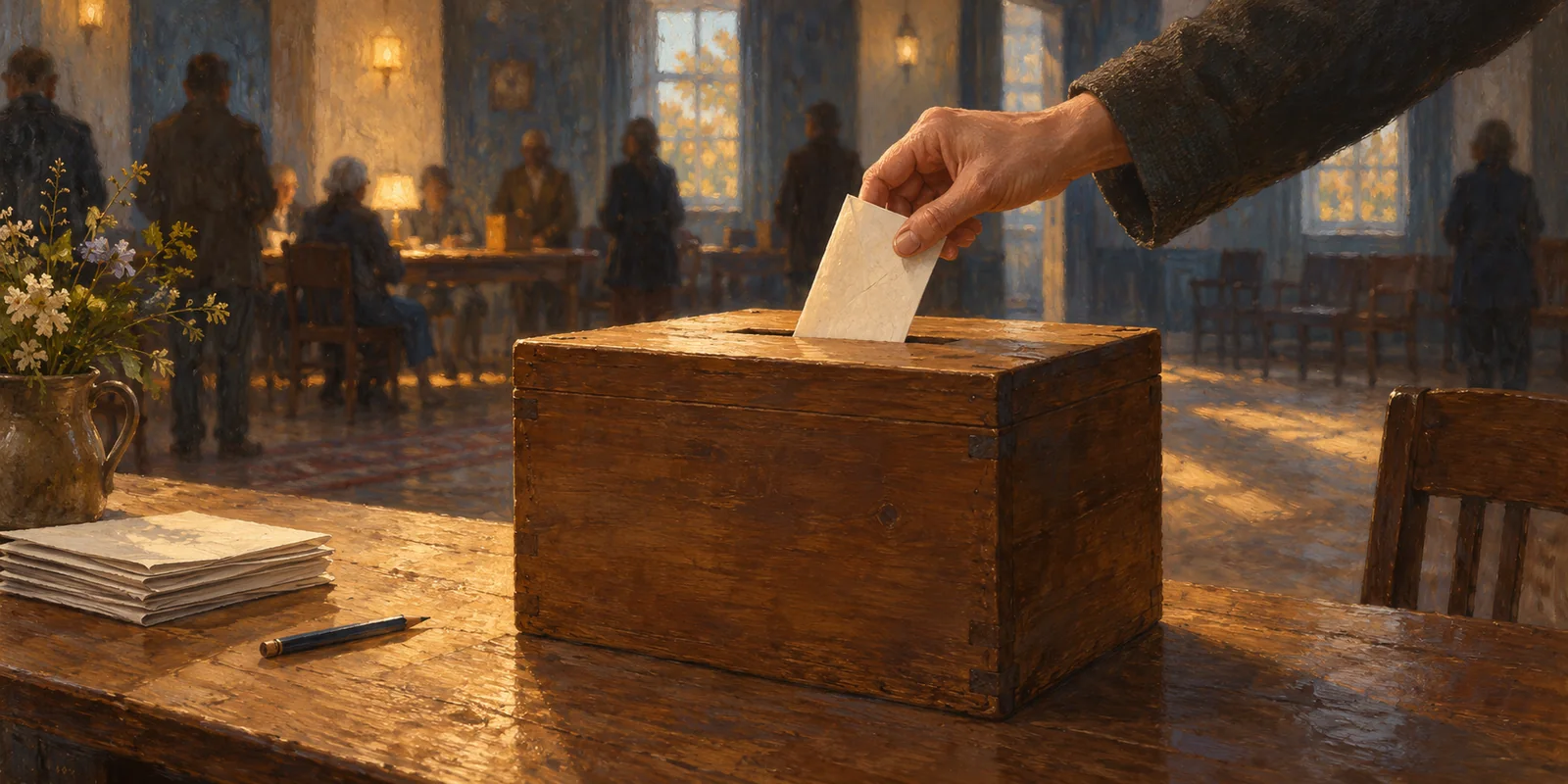
Then keep atoms for the single step that has to be both secret and final. It's one moment, a few times a decade. It can afford a pencil.
Most of the deciding people do together isn't even that hard. A housing co-op, a union branch, a software project, the members of one xNet server: they rarely need a secret ballot, and they're not facing a foreign spy agency. An open show of hands, signed so nobody can fake a hand, does the job, and that part is a solved problem. We've written the other half into our governance: xNet won't host a binding secret ballot. It isn't a feature we're behind on. It's a problem nobody has solved, and I'd rather say so than sell it.
Light is for everything you can take back. For the one thing you can't, a piece of paper, a pencil, and a room with other people in it.
Sources
- The Washington DC break-in is told by the people who did it: Wolchok, Wustrow, Isabel and Halderman, Attacking the Washington, D.C. Internet Voting System (Financial Cryptography, 2012), read in full for this essay. The forty-eight hours, the thirty-six-hour delay, the cameras and the mailing-list message are all theirs. They also saw password-guessing from Iran, India, China and New Jersey in the logs, and say plainly that it was the internet's ordinary background noise, not an attack on the election, so I have left it out of the story.
- The five requirements, the line about one programmer and millions of ballots, and the banking comparison come from Park, Specter, Narula and Rivest, Going from Bad to Worse: From Internet Voting to Blockchain Voting (2020 draft, later in the Journal of Cybersecurity). The January 2026 letter is Internet voting is insecure and should not be used in public elections, on Princeton's CITP blog, with all twenty-one names. The banking argument is made at more length by David Jefferson for Verified Voting. "Software independence" is Rivest and Wack's term, from a 2008 Royal Society paper.
- Paper and risk-limiting audits are the recommendation of the US National Academies' Securing the Vote (2018). "A few hundred ballots" is their own example and depends on a comfortable margin; close contests need far more.
- Estonia's system was examined by Springall and colleagues in Security Analysis of the Estonian Internet Voting System (2014). The online majority in 2023 is reported by Invest in Estonia, a government promotion site, so treat the framing as friendly and the number as sound.
- Voatz: Specter, Koppel and Weitzner, The Ballot is Busted Before the Blockchain (USENIX Security, 2020). The Swiss Post flaw was found by Sarah Jamie Lewis, Olivier Pereira and Vanessa Teague; the disclosure is at Open Privacy. Swiss Post has since relaunched a rebuilt system for limited trials, with public code and a bug bounty, under the Federal Chancellery.
- Kerckhoffs's rule and Shannon's shorter version, "the enemy knows the system", are summarised on Wikipedia. Heartbleed's dates and OpenSSL's staffing are from its Wikipedia entry, which cites the New York Times. The xz story is from the Open Source Security Foundation and Wikipedia. "About even" is my reading of Guido Schryen's comparison of published vulnerabilities, which is careful and more than a decade old. Machines that find bugs: Google's Big Sleep is the example I trust; I have left vendors' headline numbers out.
- Decidim began in Barcelona in 2016 and is free software.
-
Our side is in the open. Signing and checking live in
packages/sync/src/change.ts, the server's check inpackages/hub/src/services/node-relay.ts, and each device's own check inpackages/data/src/store/store.ts. "Standard settings" matters: there is a compatibility switch,allowUnsignedReplication, that turns the guarantee off, and it is off by default. The line counts are fromgit ls-fileson the day of writing. The eighty-five advisories are high or critical findings frompnpm audit --prod, now held byscripts/check-dependency-audit.mjsagainst a committed baseline so the number can only fall. The new security policy says where to send a bug. The secret-ballot rule is in GOVERNANCE.md. - Still open on the day this was published, and findable in our explorations: no reproducible builds, so nobody outside can yet confirm that a release matches the source; no answer for the web app beyond "prefer the desktop"; a threat model begun in 0134 and never finished; the end-to-end review of how a change travels, 0307, likewise; desktop releases that fall back to an unsigned-by-Apple build when our signing secrets are absent; and a newer, quantum-resistant signature scheme that is written but not yet wired into the change log. The plan for closing them is exploration 0463.