

Ester Strogen was eighty-two when her family worked out that she was renting her telephones. Two black rotary phones, the kind you dial with a finger, leased since the 1960s and still costing her $29.10 a month in 2006. Over about forty-two years her family reckons she paid more than $14,000 for equipment worth perhaps a hundred dollars.
Here is the part that stops the story being a joke at one company's expense. By the standards of her century, this was normal. For most of the twentieth century an American could not own a telephone. The handset was the phone company's property, leased with the line, and plugging in your own was forbidden. A regulator finally opened the network to customer-owned equipment in 1968, but the leases outlived the reasoning by decades. She was far from alone, either: in 2007 a successor company still had around 580,000 people paying monthly rent on telephones.
Sit with why this reads as absurd. Nobody rents a kettle. The story only works as a scandal because somewhere along the way we all agreed, without ever saying it aloud, that a household machine is a thing you own. I want to trace where that agreement came from. We are quietly tearing it up.
Eight o'clock in the apartment
There is a website I keep going back to called Ordinary Abundance, built by a researcher named Jordan Dworkin. It walks you through a modern apartment over the course of an evening. At eight o'clock the music is playing softly over the speaker; you pick up a book, flick on the lamp, settle into the chair. At nine you wander into the kitchen, rifle through the fruit bowl, open and close the fridge, put the kettle on. At ten you wash down a pill, brush your teeth, and at eleven you switch off the lights and go to bed.
Each ordinary object opens a voice from history, someone for whom that object was the edge of the imaginable. In 1888, Edward Bellamy's narrator calls music at home "the limit of human felicity": "perfect in quality, unlimited in quantity, suited to every mood, and beginning and ceasing at will". A witness in Wabash, Indiana, one of the first towns lit by electric light, describes a crowd standing "overwhelmed with awe, as if in the presence of the supernatural". When piped water reached New York in 1842, a diarist recorded the whole city shouting one word: "Water! Water!" The arrival of New England pond-ice in Calcutta moved a newspaper to rank the shippers with "other benefactors of mankind".
Its argument is about gratitude. These things were miracles; familiarity has made them invisible; it serves us, and honours the people who built them, to feel the awe again on purpose. I think that argument is right. And I want to add a second one to it, because the tour shows something else that Dworkin never quite names. Nearly every object in that apartment has the same biography.
The second walk
Start at the fruit bowl. The tour's kitchen pauses on the pineapple, with Charles Lamb in 1822 working himself into a fever about its taste. What it mentions gently, and what floors me, is how the fruit was handled a century earlier. An English-grown pineapple cost so much that people did not eat them. Hostesses rented a pineapple for the evening, displayed it as the centrepiece, and handed it back. That same fruit toured from party to party until it began to rot, and only then did somebody finally buy and eat it. A rented pineapple sounds like satire. It was simply what the miracle cost when it was new.
Then hothouses and steamships did their work, and the miracle finished its journey: from spectacle, to service, to a thing in a bowl you own outright and eat without thinking.
So did the cold in the fridge. Within two generations, that pond-ice crossing the ocean to Calcutta became the iceman on his route, and the ice arrived as a subscription. A card in the window told him how many pounds to carry up; the service came daily because the cold ran out daily. Then the electric refrigerator ended all of it — the route, the window cards, the whole daily relationship collapsed into a white box, bought once, that made its own cold. Music too: Bellamy could only imagine his endless music as a service, piped down wires from central halls, because that was what luxury looked like from 1888. What actually arrived was the record, and the shelf of them in the sitting room became the standard way a family owned its music for a hundred years.
That is the shape. Once you see it, you see it on every wall of the apartment. A miracle arrives as a service for the rich, with attendants: the concert, the iceman, the water-carrier, the rented pineapple. Then it matures into an object that ordinary people own outright, and the attendants disappear. It happened so reliably that only a monopoly could stop it: the telephone stayed leased for a century because Bell stood in the doorway. Ester Strogen's $14,000 rotary phone is what a blocked arc looks like, and we recognise her story as a scandal precisely because everything else in the room made it through.
The film runs backwards
Now look at the newest objects in the apartment. The film is running the other way.
Music got there first, which is fitting, since it led the march in both directions. Records became downloads, downloads became the stream, and the stream is Bellamy's wire service again, right down to the monthly bill. Dworkin's sitting room has a detail I find quietly devastating: the music playing at eight o'clock is "a playlist your friend made for you years ago". That playlist is a real thing your friend made, with care, and it exists only for as long as one company keeps one database answering. Stop paying, or let the company stumble, and the miracle switches off in a way no record shelf ever could. Software followed. Photoshop was a box you bought and owned for a decade; in 2013 it became a seat you rent by the month, and the industry took notes.
Devices came last, and they are the widow's telephones with better industrial design. Revolv sold a smart-home hub with a "lifetime subscription"; after Google acquired the company it published a date, and past that date, in its own words, "your Revolv hub and app will no longer work". The lifetime turned out to be the product's. Insteon is the cleaner case. There is no villain in it at all. That smart-home firm simply ran out of money in the spring of 2022, and its servers went quiet. Hubs in tens of thousands of houses went dark the same week, because nobody had designed them to work without a company attached. Spotify sold a little dashboard music player called Car Thing, discontinued it, and switched the existing ones off by remote, offering refunds only after complaints and a lawsuit.
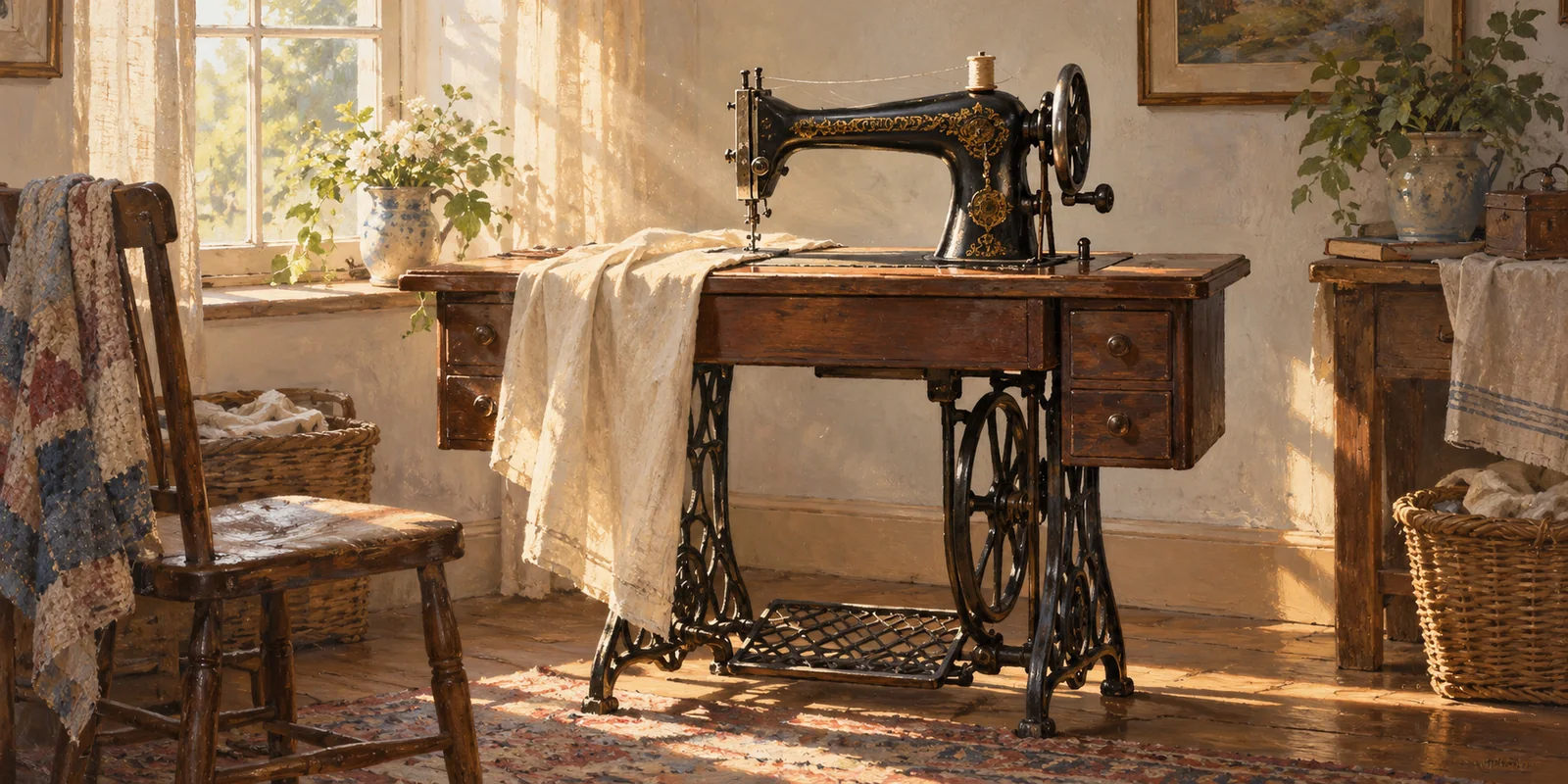
So walk the apartment one last time, asking each object the question the widow's family never got to ask. If every company that made you vanished tonight, what still works in the morning? The answers sort the room with embarrassing speed. The bulb burns, indifferent to who is still trading; the tap runs, the fridge hums, the bicycle rolls, the spectacles focus, and a book stays a book. A treadle Singer sewing machine from before the First World War will still sew you a shirt today, which is where this essay gets its title. And the speaker falls silent, the playlist evaporates, the hub bricks, and whatever lived only as an account dies with its landlord.
Notice where the line falls, because it matters more than anything else in this essay: not between physical things and digital ones. A file on your own disk survives its maker as surely as the Singer does. Lawyers have a name for what actually changed; two of them, Aaron Perzanowski and Jason Schultz, wrote a book called The End of Ownership about the moment buying quietly became licensing. The split is architectural. A machine that carries its works inside itself belongs to you, and a machine that leaves its works at the vendor's house is a terminal, whatever the receipt says. A terminal is rented even when you are told you bought it.
The receipt
I should turn the mirror around before I say anything else, because we charge a monthly fee too. xNet Cloud runs servers for people who would rather not run their own, and it bills for that every month. So you will get no sermon from me about subscriptions being wicked. The iceman charged monthly as well, and he was charging honestly: the money bought his labour, his horse, his route, an operation that genuinely ran every day. What matters was never whether money changes hands on a schedule; it is what the money buys. A fee for work someone actually does is a service, while a fee for continued access to what you would otherwise simply own is rent, and the whole history above is the history of rent losing.
Our Charter tries to hold that line with a set of written tests, and the one that belongs to this essay is called the vanish test: "if xNet‑the‑company disappeared tomorrow, what the customer paid for (their data, their audience, their workflows) survives." Insteon is the vanish test failed; the Singer is the same test passed and held for a century.
Passing it is not a mood; it is a set of build decisions, each one checkable. Your master copy lives on your own disk, and the app works with no server at all. Export is free, complete and verified, so leaving costs nothing but the decision. The protocol and the hub are MIT-licensed, which means the company dying does not take the software's legal right to exist with it. Old protocol versions are deprecated rather than cut off, so a client that worked yesterday is not made a brick by an update it never asked for. And there is a promise in the Charter I have grown fonder of than any of the grand ones: the floor. We name the oldest machine the app must run well on, a 2017-class laptop with 8 GB of memory, and a gate in our build system fails any change that quietly raises it. On why that is the only claim of its kind we make, the Charter is blunt: "'Greener' would be marketing. 'Your old laptop keeps working' is measurable, so that is the only claim we make."
The widow never got a receipt like that. Nobody offering her the lease ever had to write down what would happen to her telephones if the company lost interest, because the answer was understood: they were never hers. Modern software mostly runs on the same understanding, wrapped in a nicer onboarding flow. It seems little enough to ask that the promise be written where a build system can enforce it, rather than where a marketing team can.
Ordinary
Dworkin ends his tour at eleven o'clock, with the lights off and a head on a pillow, and closes with the thought that carries the whole site: our lives are "a gallery of past generations' heroic efforts", and it serves us, and honours them, to feel the old awe on purpose.
I would only add the condition that makes his title work. A miracle becomes ordinary abundance at a precise moment: when you no longer have to think about it. And you only ever stop thinking about a thing that cannot be taken back. Nobody checks the tap's terms of service before filling the kettle, or wonders, lifting the fridge door handle, whether the account is in good standing. That unthinking trust is not complacency. It is the finish line. The pineapple crossed it, and the ice, and the record — every machine in that apartment except the newest ones, which have been marched back to the start and handed a monthly invoice.
The awe Dworkin wants us to recover is deserved. So is the arrangement our great-grandparents fought their way to, one machine at a time, and gave to us so completely that we forgot it was ever won. The treadle Singer in the corner has been holding the standard for over a hundred years without a server, a licence check, or a renewal email. That is not nostalgia; it is a spec, and software written by people who mean it can still be built to meet it — on your own disk, on your old laptop, for as long as you care to keep it, whatever becomes of us.
Sources
- Ordinary Abundance, by Jordan Dworkin, walked end to end for this essay; his companion post on the project's motivation is on the Abundance and Growth blog. The Bellamy passage is dialogue from chapter 11 of Looking Backward (1888), where the endless music is delivered, fittingly, by wire from central halls. The Wabash, Croton water and Calcutta ice quotations are as the site presents them.
- Ester Strogen's lease was reported by NBC News / AP in 2006 and revisited by Computerworld; the figures are her family's estimates. The Carterfone decision opened the Bell network to customer-owned equipment in 1968, and QLT Consumer Lease Services still had roughly 580,000 telephone-leasing customers in 2007.
- The rented pineapple of eighteenth-century Britain is covered by Mental Floss. The iceman's rounds and their end at the hands of the electric refrigerator are described by the Smithsonian's National Museum of American History and in Wikipedia's entry on the occupation.
- Adobe's move from owned licences to monthly seats was announced in May 2013, covered by TechCrunch. Aaron Perzanowski and Jason Schultz's The End of Ownership (MIT Press, 2016) is the legal history of buying becoming licensing.
- Revolv's shutdown notice and the "lifetime subscription" it ended are covered by Techdirt and CBC News. Insteon's abrupt 2022 shutdown is covered by Hackaday and Forrester. Spotify's deactivation of Car Thing and the refunds that followed complaints are covered by PhoneArena.
-
Our side of it is in the open. The vanish test and the floor are
quoted verbatim from
the xNet Charter (§6 and §7); the floor's enforcement is the footprint gate in
scripts/check-footprint-budget.mjs, ratcheting againstfootprint-baseline.json, with the promises pinned by name inpackages/telemetry/test/charter-claims-ledger.test.ts.