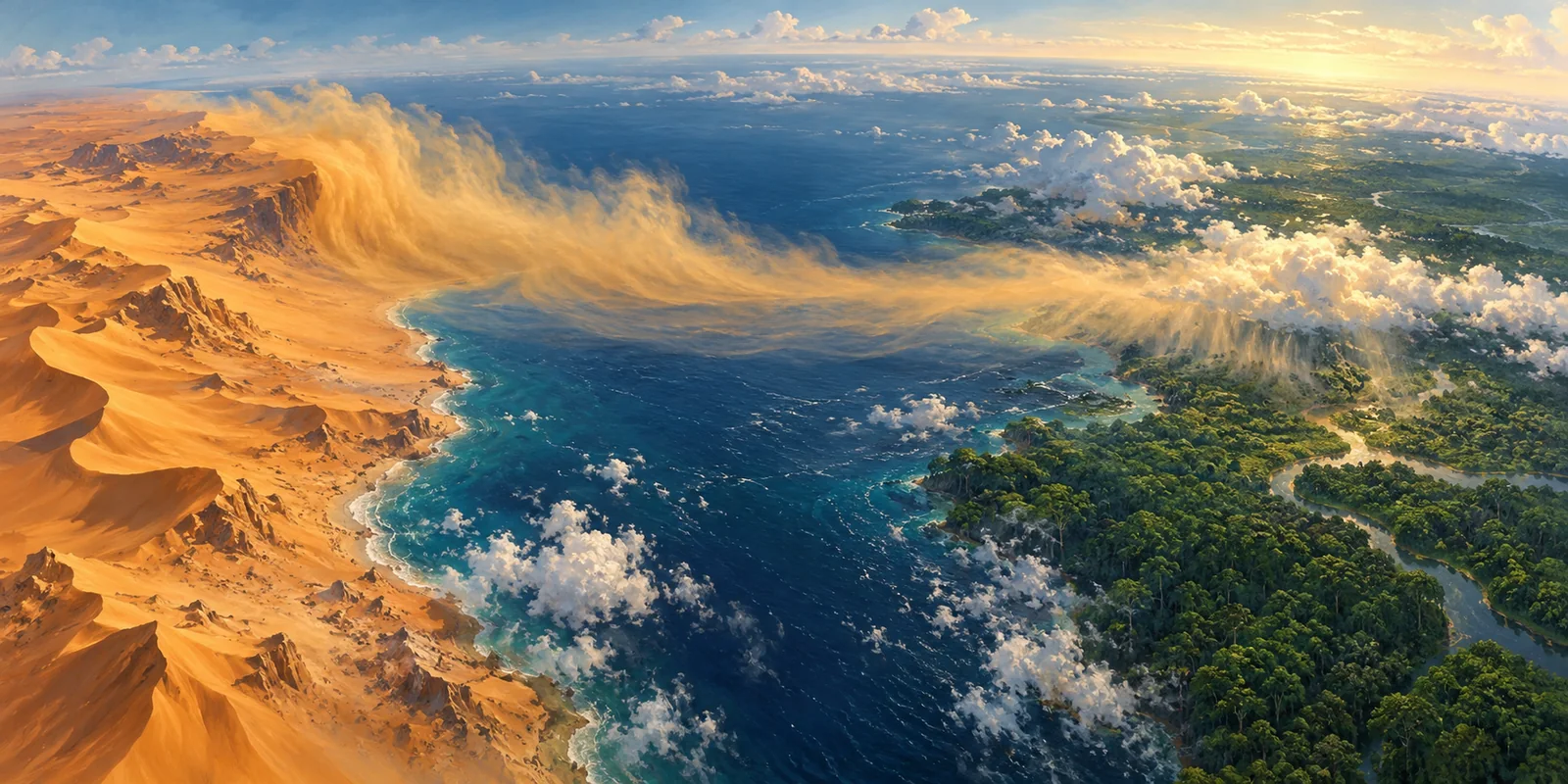


The first time, we looked up: at an open sea of scattered islands and the flags you might fly to stop being someone else’s cargo. The second time, we looked down: under the forest floor, where a fungal network older than any human one trades food and news in the dark. The third time, we looked all the way up, to the star that was in our logo the whole while. This time, look across: at the wind, and at a thing it carries that almost nobody has ever noticed.
I got here by way of a video with a thumbnail engineered for your thumb: “They Dropped Millions of Frozen Bees into the Sahara. 1 Year Later, the Results Are Unbelievable!” More than a million people have watched it. It is, to be blunt, fiction: an AI-narrated “documentary” about an experiment that never happened, with fake chapters and a premise that falls apart the moment you poke it. You cannot airlift frozen bees into the deadliest desert on Earth and get a jungle. But clumsy as it was, it was pointing at something (two real things, actually) and the real things are stranger and lovelier than the lie. That’s the whole essay, so let’s say it once, plainly: the important thing is almost never the thing on the surface. It’s the part nobody optimised for a thumbnail.
The most lifeless place on Earth feeds the most alive one
Here is the fact that should rearrange how you see a map. Every year, on the order of 27.7 million tons of Saharan dust ride the wind clear across the Atlantic and settle onto the Amazon rainforest, the share that finishes the crossing, out of the roughly 182 million tons that lift off the desert in all. Not a stray gust: a planetary conveyor belt, measured from orbit by NASA’s CALIPSO satellite across seven years of data. So the most lifeless place on the planet is quietly raining fertiliser on the most alive one, four thousand miles away.
And it isn’t just dirt. The Amazon sits on ancient, weather-beaten soil that is desperately short of phosphorus, the one nutrient a forest can’t grow without, because the heavy rains that make a rainforest a rainforest also wash the phosphorus out, year after year. The dust carries roughly 22,000 tons of phosphorus with it, and here is the part that sounds invented: that’s close to the exact amount the forest loses to the rain. The desert refills the leak. Cut off the dust, and the greatest forest on Earth would slowly, quietly begin to starve, and it would happen so far from the cause that nobody watching the trees die would ever think to blame a desert.
Now follow the dust back to its source, because this is where it stops being a nice fact and starts being a parable. The richest of it comes from one place: the Bodélé Depression in Chad, a cracked white wasteland that was, within the last several thousand years, the bed of a vast freshwater lake. The phosphorus is so concentrated there because the dust is made largely of diatoms, the skeletons of microscopic creatures that lived and died in that lake before recorded history. So the true story is this: the fossils of life that died millennia ago, blown off the floor of a lake that no longer exists, are what keep a living rainforest breathing today. Death feeds life. The wasteland is the supply line. And not one creature in that forest has the faintest idea.
The forest isn't self-sufficient. Neither is the web.
A dead lakebed in Chad fertilizes the most alive place on Earth — replacing almost exactly what the rainforest loses. The visible web runs on the same kind of subsidy, from a substrate it never pays for.
-
A desert that looks dead
Open protocols, RSS, email, DNS — and the maintainers nobody thanks. The boring, inert-looking substrate.
-
~22,000 tons of phosphorus a year, lofted across an ocean
Standards, specs, and unpaid labor flowing upward into everything that looks alive.
-
≈ exactly what the forest loses to rain
The commons silently replacing what the platforms strip-mine out of it.
-
Cut the dust and the forest starves — slowly, and far from the cause
Enclose the commons and the web decays — quietly, years later, blamed on everything else.
The forest can't see the desert that feeds it, so it's easy to mistake the canopy for the whole story. The web makes the same mistake — and the substrate is depletable.
The bee nobody watches
The video was wrong about the bees, but it was wrong in an interesting direction, because there are desert bees, and they are their own small miracle of the invisible. When you picture a bee, you picture the honeybee: the hive, the honey, the waggle dance, the mascot on the “save the bees” tote bag. But the honeybee is the exception. Most bees are solitary: no hive, no colony, no honey, no brand. And the desert species are the most patient creatures you’ll never see: they wait out the drought sealed underground, sometimes for years, and emerge only when the rare rains bring a bloom worth pollinating.
They work like a keystone species: small in number, invisible in operation, catastrophic in absence. The pollination they do quietly holds up the wildflowers, which hold up the insects, which hold up the birds and the lizards and everything above them. Pull the keystone and the arch comes down. And yet they get no posters. The charismatic, managed honeybee is the face of the cause; the unbranded solitary bees do an enormous share of the actual work, and they are the ones genuinely, quietly vanishing. We are very good at noticing the mascot and terrible at noticing the worker.
Hold those two pictures together, the dust you can’t see and the bee you never watch, because they’re the same picture. A visible, thriving world resting on an invisible substrate that gets no credit and no protection. Once you’ve seen that shape in the desert, you start seeing it everywhere. Including in the thing you are reading this on.
The web is a forest that forgot its desert
The internet you actually touch (the apps, the feeds, the five glassy platforms where most people now spend their hours) feels gloriously self-sufficient. It looks like the Amazon: lush, busy, obviously alive. But it is not self-sufficient, any more than the forest is. It is fed, every second, by a substrate almost nobody looks at: the open protocols. HTTP and DNS and TCP/IP and email and RSS: the plain, unglamorous, decades-old agreements that let a message from anywhere arrive anywhere. Nobody owns them or monetises them directly. They are the dust on the wind, and the entire visible web grows in them.
And like the dust, they have a source made of patient, half-forgotten labor. A researcher named Nadia Eghbal wrote the definitive account of it, and her title says it all: Roads and Bridges: The Unseen Labor Behind Our Digital Infrastructure. The open-source maintainers who keep the world’s code alive, she argued, are the keystone species of digital infrastructure, there it is again, doing work that is, in her words, “invisible precisely because it works.” You only ever see it when it breaks. The whole web shuddered when a single under-funded encryption library sprang the Heartbleed bug; for one news cycle everyone learned that the padlock in their browser had been quietly held up, for years, by a tiny handful of volunteers. Then the cycle ended and we forgot again. The dust kept blowing. Nobody thanked it.
So what is Big Tech, in this picture? It is the monoculture. A walled platform is a plantation: from a distance, dense and green and productive, and up close, a system that strip-mines the substrate it grows in and puts nothing back. It takes the open protocols, the free labor, the shared standards, and the public square of human conversation, and it encloses them, wrapping a fence around the commons and selling you a ticket back in. For a while the plantation thrives, because the soil it inherited was rich. But a monoculture sterilizes its own ground. It kills the link, the open API, the small independent site, the interoperable feed, the very dust that fed it. The loss is slow and deniable, the way a far-off forest starves long after the wind has stopped. We have a name for the result already. People call it the dead internet, and they say it sadly, and they mostly blame the trees.
Now for the honest part, because the cosy version of this (“the noble open web versus the wicked platforms”) is oversold the same way the “frozen bees” were.
An honest desert
A metaphor that flatters itself is just more marketing. Here’s the honest version.
- ✕
We won’t pretend the bees grew a rainforest.
✓The video that started this — millions of “frozen bees” airlifted into the Sahara to make it bloom — is fiction, AI-narrated for the click. You can’t do that, and nobody did. The real marvels are quieter and far better documented: the dust bridge, and the keystone bee.
- ✕
We won’t pretend the balance is exact.
✓“The dust delivers exactly what the Amazon loses” is a headline. The phosphorus figure (~22,000 tons/yr) is a satellite-era estimate with real error bars, and how much of it plants can actually use is still debated. It’s close enough to be astonishing — not an accountant’s match.
- ✕
We won’t say “save the bees” and mean the honeybee.
✓The honeybee is a managed, semi-domesticated mascot with great PR. The load-bearing pollination is done by thousands of solitary species with none — and they’re the ones quietly disappearing while the mascot gets the posters.
- ✕
We won’t pretend open protocols run themselves.
✓The commons is real but it isn’t free. Maintainer attention is finite and depletable; calling open infrastructure “free” is precisely how it gets strip-mined. A substrate you don’t replenish is one you’re spending down.
Keep what survives the scrutiny, because it’s the useful part: a visible world standing on an invisible substrate, and that substrate is depletable: you can spend it down to nothing if you only ever extract from it. That’s not a fairy tale; that’s an engineering problem. And engineering problems have solutions.
Build like the dust, not like the plantation
Here is the choice, drawn as plainly as the desert draws it. You can build like the plantation: enclose what you didn’t make, extract until the ground is dead, and call the green months “growth.” Or you can build like the dust: be the substrate that travels freely, asks for nothing, and quietly refills the leak so the living thing downstream keeps breathing. xNet is a bet, with receipts, on the second one.
- You hold the master copy. Your data lives on your device first and works with no network at all; there is no behavioural surplus harvested behind your back, because there’s no place in the architecture to put it. The plantation’s whole economy is harvesting you. The dust doesn’t harvest anyone, and you can read that in our commitments, and a check in the build fails if anyone tries to smuggle a tracker in.
- Leaving loses nothing. Your identity is a
did:keyyou generate yourself. Nothing issues it, nothing can revoke it, and it works on any hub. Your history is an open, signed, hash-chained log, not a vendor blob. You can take everything and go, the way dust owes no allegiance to the desert it left. A platform that makes leaving cost you is a fence; an open one is the open sky. - Coherence from a shared law, not a landlord. Every change travels as a signed packet over one open protocol, pinned to a corpus of conformance tests every implementation has to pass. Strangers interoperate because they obey the same rules, not because they rent the same server. That’s how dust from one continent nourishes a forest on another: a shared chemistry, not a contract.
- Calm on purpose. No infinite scroll, no engagement ranking, no streaks engineered around the fear of losing them. We don’t compete for your time; we compete for your wellbeing. The dust isn’t trying to keep you scrolling; it’s trying to leave the ground better than it found it.
None of that is charity, and none of it is new. It’s just the oldest pattern in the living world, the one the Sahara has been running on the Amazon since before there were people to miss it: give more than you take, freely, to something that can’t see you doing it. A forest that’s fed that way doesn’t owe the desert. It just gets to keep being a forest.
Notice the invisible thing
We went looking, half as a joke, in a clickbait video about frozen bees. We found a dead lake in Chad keeping the Amazon alive, a bee that waits years underground for one good rain, and a handful of unpaid maintainers holding up the padlock on every page you visit. The lesson is the same in all three, and it’s the lesson the open web most needs us to learn: the thing doing the most important work is usually the thing you can’t see, can’t name, and never thank. The dust, the bee, the protocol, the maintainer, the commons.
So notice it. Read the receipts on what the visible web actually costs you. Over three years, the average person’s data reached a single platform from roughly 2,230 different companies; your device’s quirks alone can pick you out of the crowd about 99% of the time. Then go build, or use, or fund something that feeds the forest instead of farming it. Use the app, free, offline, and private. Or build something of your own on the open protocol, and become a little more dust on the wind.
We set out to sea; we put down roots; we named the star in the logo; and now we’ve followed the wind across an ocean to a forest that doesn’t know what keeps it alive. Same open world, four ways of looking at it. Sea, soil, sky, and the sand that crosses between them.
Sources
- The dust bridge — ~27.7 million tons of Saharan dust reaching the Amazon each year, carrying ~22,000 tons of phosphorus, close to what the forest loses to runoff, measured by the CALIPSO satellite: NASA Goddard — How much Saharan dust feeds the Amazon’s plants and ScienceDaily — Saharan dust fertilises the Amazon (Yu et al., 2015).
- The Bodélé Depression — an ancient lakebed whose phosphorus-rich dust is largely the fossils of freshwater diatoms: EarthSky — Saharan dust feeds the Amazon, perfectly and Mongabay — How the Sahara keeps the Amazon going.
- Solitary desert bees as invisible keystone pollinators (most bees are not honeybees; desert species lie dormant and emerge after rain): USDA-ARS — Specialized bees power desert ecosystems.
- The invisible labor under the web — open-source maintainers as the “keystone species” of digital infrastructure, “invisible precisely because it works,” and the Heartbleed wake-up: Nadia Eghbal — Roads and Bridges (Ford Foundation, 2016) and xkcd 2347 — “Dependency.”
- The surveillance figures and their citations: xNet — Why. The architecture and commitments: the Humane Charter. The companion essays: A Great Pirate Age for the Internet, Data Should Work Like Soil, and The Gentlest Furnace.
This is an independent essay. The “frozen bees in the Sahara” video is referenced as the sensational surface that pointed, accidentally, at real science; the dust-bridge and pollinator figures are real but rounded, and are used here as metaphor, not as a precise ecological model. All artwork here is original.