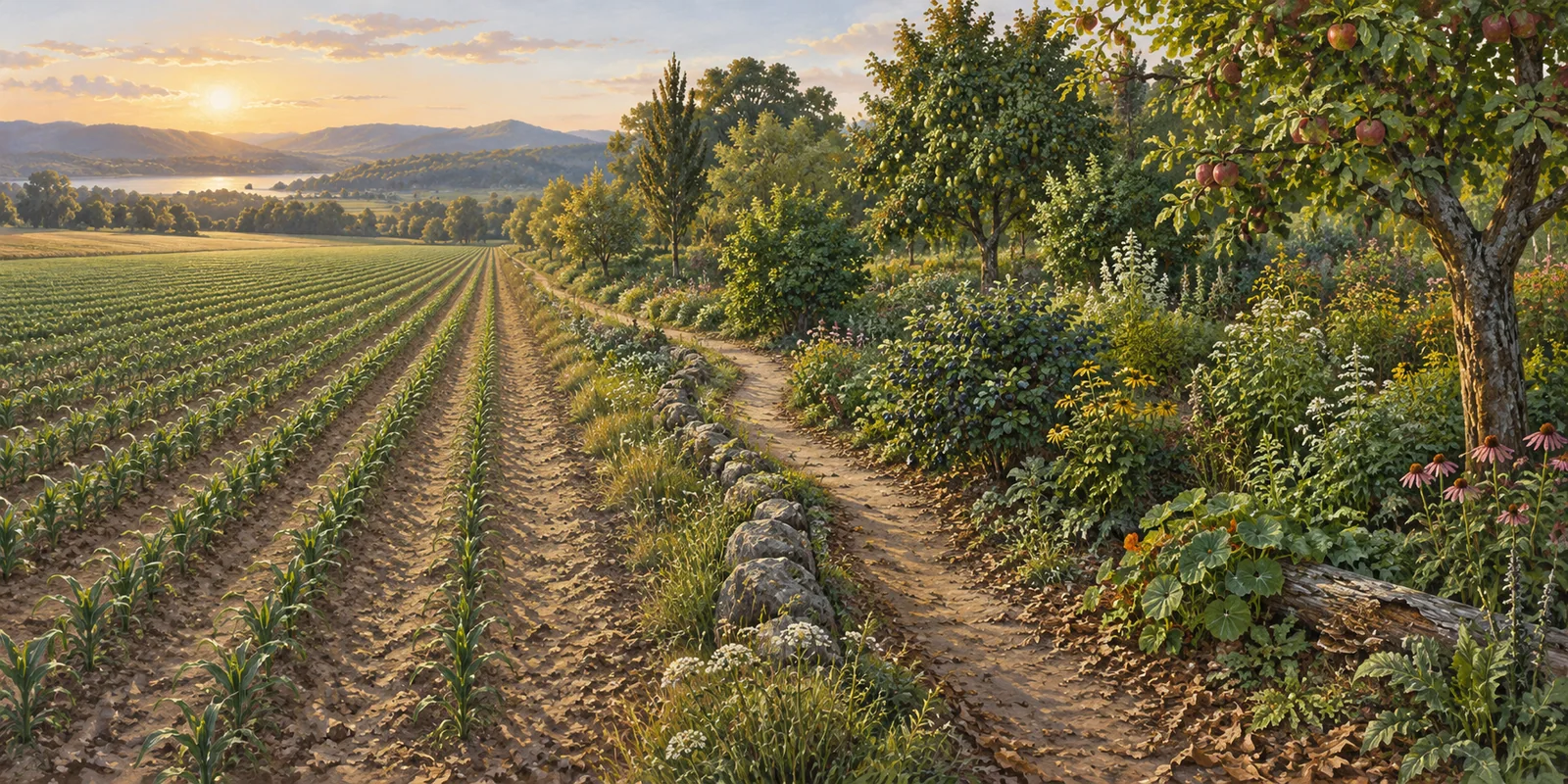


A few of these essays have wandered underground and overhead: into the soil a forest quietly talks through, into the dust a dead desert sends across an ocean to feed a living one. This one stays at eye level, on an ordinary patch of ground, and asks a plainer question. Not how does a living system work, but how does a person sit down and grow one on purpose? Because there is a discipline for exactly that, and once you’ve seen it, you can’t un-see it in the web.
Two pieces of land
Picture a field of corn. A thousand identical rows running to the horizon, every plant the same height, the same age, the same genes. It is the image most of us carry of a farm, and it is, by one measure, a triumph: more calories per acre, per hour of human labor, than almost anything in history. It is also a patient on life support. The bare soil between the rows washes away with every rain. A single crop is a single feast laid out for a single pest. And the fertility doesn’t rise from the ground, which is close to dead. It arrives in a truck, as nitrogen brewed from natural gas, and it leaves again in the harvest, so it has to be bought back next season, and the season after, forever. The field looks like abundance. It runs on dependency.
That field is the business model of the modern web, where the crop is your attention, planted in dead-straight rows and harvested on a schedule, and the soil is you: your behavior, tilled for the one nutrient the operation actually wants. The fertility that keeps the whole thing green is sold back to whoever planted you, as ads, as reach, as a ranking you can rent. It is enormously productive, for a while, for someone else. And like any monoculture, it is quietly sterilizing the ground it grows in: the open link, the interoperable feed, the small independent site, the very things the platforms first grew out of, are dying off, row by row, and we’ve started, sadly, to call the result the dead internet.
Now picture the second piece of land. It doesn’t look like a farm at all. It looks like a young forest gone slightly feral: fruit trees over berry bushes over herbs over ground cover, vines threading up through all of it, seven layers deep, nothing in rows. Bees and birds and fungi do half the work. Nobody trucks in fertility, because the system makes its own: leaves fall, roots fix nitrogen, everything that dies feeds something that lives. It needs less every year instead of more. And here is the part worth sitting with: that tangle is not wild. It was designed, every inch of it, by someone following a discipline with an ugly portmanteau for a name, permaculture.
The other way to farm
Permaculture (permanent + agriculture, and later culture) was set down in the 1970s by two Australians, Bill Mollison and David Holmgren, watching industrial farming strip the topsoil off their continent. Their wager was that you could get a real yield from land by designing it to run the way a healthy ecosystem already does: diverse, layered, self-renewing, mostly self-maintaining. It rests on three ethics that fit on a seed packet: earth care, people care, and fair share (return what’s surplus to the system instead of hoarding it), and on twelve design principles underneath them.
The whole thing turns on one distinction that most “green” technology just misses. Being sustainable means doing less harm, and a slower death is still a death, whereas being regenerative means leaving the land richer than you found it. A monoculture, at its very best, is sustainable: you can tune it to deplete the soil a little more slowly. A forest is regenerative: it builds soil it never had. The question permaculture asks of a piece of land is the question worth asking of a technology, and almost nobody asks it: not “how do we extract from this a bit more responsibly,” but “how do we build a thing that leaves the commons better off for having existed?”
That question is the whole of xNet’s commitments, and it turns out the twelve principles map onto them almost furrow for furrow. Suspiciously well, in fact, so we’ll be honest about that further down. But take them in four movements first.
One: store what you grow
The first cluster of principles is about where the good stuff lives. Catch and store energy, make hay while the sun shines, means capturing abundance at the source and keeping it somewhere you can reach it later, rather than letting it run off. The monoculture web does the opposite: your data is the harvest, and it’s trucked off your land the instant it’s made, to be stored in someone else’s silo and rented back to you as a “sync.” xNet keeps the harvest in your barn. Your data lives on your device first, as the master copy, working with no network at all. You caught it; you keep it.
Produce no waste (waste is just a resource in the wrong place) is the principle the extractive web most spectacularly violates, and the violation has a name. Shoshana Zuboff called it behavioral surplus: the exhaust data scraped from your every tap that you never agreed to hand over, the runoff the whole industry was built to capture. xNet produces none of it. There is no place in the architecture to put it, and a check in the build fails if anyone tries to add one. And waste isn’t only what’s harvested; it’s also what’s stranded. On a plantation, leaving means losing your crop. Here, you can export everything and walk, and nothing rots in the ground behind you.
Use and value renewable resources. A permaculturist
reaches for the input that refills itself: sunlight, not fossil fuel.
Proprietary formats are fossil fuel: dig them up once, and you’re locked to
a single supplier who can change the price. Open standards are sunlight.
Your identity on xNet is a did:key you mint yourself. Nothing
issues it, nothing can revoke it, and your history is an open, signed,
hash-chained log any implementation can read. Renewable, portable, and not
anyone’s to switch off.
Two: let it regulate itself
Observe and interact: understand a system before you act on it. The extractive web has perfected the dark inversion of this principle: it observes you obsessively, but only in order to act on you. xNet flips it back the right way round. Telemetry is off by default; nothing about you is observed until you choose to share it, and even then it’s scrubbed and bucketed so a single person can’t be picked out of the crowd. Observation in service of the gardener, not the harvest.
Apply self-regulation and accept feedback. A forest doesn’t grow without limit; it finds a balance, and when something is off, the feedback is loud and the system adjusts. The monoculture web is engineered to ignore exactly this signal, to override your “enough” with one more autoplay, one more infinite scroll, one more streak you’ll lose if you sleep. xNet writes the limits into the code instead of leaving them to willpower: notifications are rule-based with a hard cap, feeds are chronological, there’s no engagement ranking and no loss-baited streak, and a build check fails if a dark pattern or a manipulative animation tries to sneak in. The system accepts feedback by refusing to ship the thing it promised not to build.
Use small and slow solutions. Big and fast is fragile; small and slow is what lasts and what a human can actually tend. The whole architecture is small and slow on purpose: local-first, hubs modest enough to run yourself, a deliberately calm motion vocabulary. Not the hyperscale web. The small one, built to be kept.
Three: plant a polyculture
Use and value diversity. Monoculture’s fatal flaw is that it is one bad day (one blight, one pest, one outage) from total collapse; a polyculture routes around the damage because something else is always thriving. A web owned by five companies is a monoculture in exactly this sense. xNet is built to be a polyculture: it runs under any framework and speaks several languages, and, the deepest diversity guarantee there is, you can fork it. The only thing held back is the name, and only so that no one can impersonate you; the code itself is yours to replant anywhere.
Integrate rather than segregate. In a garden the work gets done in the relationships between things: the nitrogen-fixer feeding the fruit tree, the flower drawing the pollinator. A silo, by definition, has no relationships; that’s the whole idea of a wall. The extractive web’s instinct is to wall you in and meter the door. xNet federates instead: bring your own hub, connect it to others, interoperate by a shared set of rules rather than a shared set of fences.
Design from patterns to details: get the big shape right before you fuss over the specifics. xNet’s big shape is a single open protocol: a signed, hash-chained change log that everything else is grown on top of. The apps and the features are details, important ones, but details rooted in a pattern that doesn’t belong to any one of them. Get the soil right and many things can grow in it.
Four: tend the edges, and design for change
Use edges and value the marginal. The most alive place in any landscape is the edge: the ecotone where forest meets meadow, where species from both worlds mingle and new ones appear. The web has an edge too, and it’s your device, sitting at the far margin of every network diagram. That margin is precisely where xNet puts the data and the work. It’s also a quiet reminder to value what the center overlooks: the people a platform won’t bother to serve, and the maintainers nobody thinks to thank, who turn out to be holding the whole thing up.
Creatively use and respond to change. Change is not a threat to design around; it’s the one thing you can count on, so you build to bend with it. The deepest version of this is the right to leave. Platforms turn, and they almost always turn, and when yours does, you should be able to respond by simply walking out with everything intact. A portable identity and an open log turn a platform going bad from a sentence you serve into a problem you solve in an afternoon.
And finally, the principle that keeps the other eleven honest: obtain a yield. A design that doesn’t actually feed the people tending it won’t be tended; beautiful, useless idealism composts back into nothing. This is the one most “ethical tech” forgets, and it’s why xNet is not a manifesto but working software you can use today. The yield it returns is the very thing the monoculture rents back to you at a markup: your own audience, your own space, your own data, kept.
Twelve principles, one design
Holmgren's twelve permaculture principles, grouped into four movements — and what each one becomes when you build a web instead of a garden.
Store what you grow
-
Catch & store energy
Your device holds the master copy — your harvest, in your barn, working offline
-
Produce no waste
No behavioral surplus to harvest; nothing stranded when you export and leave
-
Use renewable resources
Open standards over proprietary lock-in: a did:key you mint, a signed open log
Let it regulate itself
-
Observe & interact
Telemetry off by default — observed only with consent, scrubbed so it can’t fingerprint
-
Self-regulation & feedback
No infinite scroll or engagement ranking; a build check fails on dark patterns
-
Small & slow solutions
Local-first, run-it-yourself hubs, a calm motion vocabulary — the small web
Plant a polyculture
-
Use & value diversity
Any framework, many languages — and the freedom to fork; only the name is protected
-
Integrate, don’t segregate
Federation and interop by shared rules, not a wall around the commons
-
Patterns before details
One open protocol is the pattern; every app and feature is a detail grown on top
Tend the edges, design for change
-
Use edges & the marginal
The edge is your device — that’s where the data and the compute live
-
Respond to change
The right to leave: when a platform turns, you walk out with everything intact
-
Obtain a yield
Not a manifesto — working software today; the yield is your own audience and space
If that felt a little too neat, six commitments and twelve principles clicking together like rows in a furrow, good. It should make you suspicious, and the honest version is worth more than the tidy one.
An honest garden
A metaphor that flatters itself is just more marketing. Here’s where the land-to-software analogy actually strains.
- ✕
We won’t pretend code is scarce the way soil is.
✓A field obeys thermodynamics; software copies for free. So “yield” and “waste” are borrowed words here, not equations. The yield we mean is problems solved and people served; the waste we refuse is the behavioral exhaust harvested from you — not a deprecated library, which costs nothing to leave lying around.
- ✕
We won’t pretend software ecosystems heal themselves.
✓A forest self-regulates over evolutionary time. A package registry does not — left-pad, the XZ Utils backdoor, and Log4Shell are what “self-healing” actually looks like in software: it doesn’t, without funded, vigilant maintenance. The commons is real, but its upkeep is finite and depletable, and calling it “free” is how it gets strip-mined.
- ✕
We won’t let the metaphor launder power.
✓Calling a dominant platform a “climax species” makes capture sound like nature taking its course. It isn’t. Monopoly is built from network effects, acquisitions, and regulatory capture — choices, not succession. The forest is a model to design by, not an alibi for who’s already won.
- ✕
We won’t oversell permaculture itself.
✓Its productivity claims are thinner on peer-reviewed evidence than its confidence suggests, and it carries some guru-and-certificate baggage. We’re borrowing a way of thinking about regenerative design — store, recycle, diversify, decentralize — not claiming a settled science.
The commons isn’t doomed. It’s being fenced.
There’s one objection left, and it’s the oldest one. In 1968 a biologist named Garrett Hardin published an essay called The Tragedy of the Commons, and its logic has been used to justify enclosure ever since: a shared pasture, he argued, is always overgrazed, because each herder gains from adding one more animal while the cost of the ruin is spread across everyone. Anything held in common is therefore doomed, and the only cures are to privatize it or police it. For fifty years that’s been quoted as a law of nature.
It isn’t one. The economist Elinor Ostrom won a Nobel Prize for showing it isn’t. She went and looked at irrigation systems, fisheries, alpine pastures, forests held in common for centuries, and found communities governing shared resources perfectly well without either a landlord or a state, using rules they wrote and enforced themselves. Hardin had described a commons with no governance and mistaken it for all of them. Ostrom described what happens when people actually tend the thing they share.
And some commons don’t even face the tragedy; they run the other way. The legal scholar Carol Rose named it the comedy of the commons: resources that get more valuable the more people share them: a language, a road network, a protocol. The open web is one of these: every person who adopts an open standard makes it worth more to everyone already on it. For a comedy commons, the danger was never that we’d use it up. The danger is that someone fences it and starts charging at the gate.
So xNet’s commons aren’t a charity drive; they’re governance, in Ostrom’s sense. The code is forkable, the hubs are yours to run, and the rules are written down and meant to be shared and argued with. That’s not idealism about human nature, but the boring, well-evidenced machinery that lets a shared thing stay shared instead of getting quietly enclosed while everyone was looking at the canopy.
Plant the forest
You do not reform a monoculture by standing at the fence and arguing with it. The field can’t hear you; it’s busy being a field. You reform it the way nature reforms a clear-cut: you plant something diverse and slow and alive at the edge of it, and you tend that, and you wait. The field wins the first few seasons. It always does; that’s what the chemicals are for. But the field is spending soil it has to keep buying back, and the forest is building soil it gets to keep, and of those two stories only one of them gets richer every single year.
So plant the forest. Use the app, free, offline, and private, or build something of your own on the open protocol and add a species to the canopy. Read what the monoculture actually costs you, then go grow a web that feeds itself. The whole discipline comes down to one instruction, and it’s the same on land as it is online: leave it richer than you found it.
Sources
- The framework — three ethics and twelve design principles: permacultureprinciples.com, after David Holmgren, Permaculture: Principles & Pathways Beyond Sustainability (2002), and Bill Mollison, Permaculture: A Designer’s Manual (1988).
- Permaculture applied to computing, where much of this thinking has been worked out already: permacomputing.net and the Hundred Rabbits collective.
- The commons — that sharing isn’t doomed: Elinor Ostrom, Governing the Commons (1990); Carol M. Rose, The Comedy of the Commons (1986); and the essay it answers, Garrett Hardin, The Tragedy of the Commons (1968).
- The invisible, depletable labor under the open web: Nadia Eghbal — Roads and Bridges (Ford Foundation, 2016).
- “Behavioral surplus,” the runoff this whole web was built to capture: Shoshana Zuboff, The Age of Surveillance Capitalism (2019).
- The architecture and the receipts behind every claim here: the Humane Charter and xNet — Why. Companion essays: Data Should Work Like Soil and The Desert That Feeds the Forest.
This is an independent essay. Permaculture is used here as a design analogy, not a settled agricultural science; the land-to-software mapping is meant to be useful, not literal, and its limits are spelled out above. All artwork here is original.